
Yolo County Parole vs Probation
Parole and probation both describe supervision after a custody or court event, but they are not the same record. In Yolo County, probation usually flows from a Yolo Superior Court order and is handled by the Yolo County Probation Department. State parole usually follows a California Department of Corrections and Rehabilitation prison term and is handled by the CDCR Division of Adult Parole Operations. A jail release alone does not prove either status.
| Supervision type | Who handles it | Best verification path |
|---|---|---|
| County probation | Yolo County Probation Department | Yolo Superior Court order, then Probation contact |
| Mandatory supervision or PRCS | County probation or local supervision channels | Court minute order, Probation contact, records request if public |
| State parole | CDCR DAPO Northern Region | CIRIS, BPH result if applicable, then DAPO unit |
| No supervision | No supervising office named | Court disposition and release record show sentence completion or case status |
- Parole
- Supervision after release from state prison or another CDCR parole-eligible path.
- Probation
- A court-ordered sentence or supervision term served in the community under county authority.
- Discharge
- The end of custody or supervision when the controlling agency closes that status.
- Absconder
- A supervised person alleged to have stopped reporting or left supervision contact.
Check Yolo County Supervision
The cleanest verification path follows the paper trail. Start with the custody event, then confirm the legal order, then contact the agency that has supervision authority. A person may leave Monroe Detention Center because bail posted, a court ordered release, a sentence was completed, a transfer occurred, or a probation term began. Each reason points to a different follow-up source.
- Call the Yolo custody-status line at 530-668-5245 if the question is whether the person is still in county jail, whether a hold exists, or whether a tentative release date was listed.
- Search the Yolo Superior Court Tyler portal for the case number, minute order, probation order, revocation, termination, or sentence.
- Use CDCR CIRIS when the case moved from Yolo County to state prison or CDCR parole.
- Check the Board of Parole Hearings results only for qualifying CDCR cases. A grant is a recommendation subject to further review, not instant release.
- Contact Yolo County Probation or CDCR DAPO only after the record shows which agency is involved.
For a broader release-record path, the home page explains how the jail record, court record, VINE event, and CPRA request fit together for Yolo County released inmates.
Yolo Supervision Office Contacts
Yolo has local county probation offices, but CDCR parole for the Yolo/Woodland area is listed by CDCR under a regional unit outside Yolo County. That distinction matters. A caller looking for state parole in Woodland may not find a Woodland storefront in the CDCR directory, while county probation has offices in Woodland and West Sacramento.
Yolo County Probation Department
725 Court Street
Woodland, CA 95695
(530) 406-5320
Monday-Friday, 8:00 a.m.-12:00 p.m. and 12:30 p.m.-4:30 p.m.
500-A Jefferson Boulevard
West Sacramento, CA 95605
(916) 375-6418
Monday-Friday, 8:00 a.m.-12:00 p.m. and 1:00 p.m.-4:00 p.m.
CDCR DAPO Vallejo and Woodland
2320 Courage Drive, Suite 103
Fairfield, CA 94533
(707) 428-2250
Listed in the CDCR Northern Region directory.
The California Board of Parole Hearings is separate from DAPO. BPH decides parole suitability for qualifying CDCR cases; DAPO supervises after release to parole.
Yolo Alternative Custody Release
Yolo's local release landscape includes the Sheriff's Alternative Sentencing programs at the Leinberger Center. SWIP and Electronic Monitoring/Home Custody can make a person look released from standard jail placement while a court-ordered commitment is still active outside traditional custody. That is a Yolo-specific reason to compare more than one source before treating a missing jail entry as a completed sentence.
The Alternative Sentencing page lists the Leinberger Center at 140A Tony Diaz Drive in Woodland and phone (530) 668-5260. Office hours are Monday-Friday, 8:00 a.m.-12:00 p.m. and 1:00 p.m.-4:00 p.m., excluding county holidays. Eligibility and approval depend on the court order and program review.
Alternative Sentencing also shows why supervision questions should not be answered from the jail roster alone. A court commitment can be served through a nontraditional program while the person still has reporting duties, program rules, and a court case to track. In that situation, the useful documents are the Yolo minute order, Alternative Sentencing instructions, and any probation or supervision order that follows release processing.
Note: Alternative custody is not the same as being off supervision or done with a sentence.
Yolo Violations and Warrants
Conditions are the rules attached to supervision. They can include reporting, treatment, travel limits, court compliance, search terms, or no-contact orders. The public record may show that a violation, revocation, warrant, or modification occurred, but it may not show every detail of a supervision plan. For Yolo County probation, the court record is usually the best public starting point because orders and revocation events are court actions.
CDCR DAPO has statewide wanted-offender resources for certain sex-offender parole cases, but a Yolo-specific public absconder list was not found in the official county pages reviewed. Do not infer a warrant from the fact that a person is not on the jail roster. Check the Yolo Superior Court record, the custody line, and the responsible supervision office.
Property After Yolo Release
Supervision verification often happens at the same time as practical release tasks. Yolo's Property & Evidence page says property is released by appointment only, requires valid government photo ID, and allows an authorized designee with written permission. It also notes that a recent Yolo booking photo may be used for identification during property pickup.
That property process does not prove parole or probation status. It is a separate operational step after a jail booking. Use it for property questions, then use the court, Probation, DAPO, or CDCR record for supervision questions.
Yolo Supervision Discharge Records
Supervision ends through the agency and court path that created it. County probation may end through completion, termination, revocation, modification, or another court order. State parole may end through CDCR discharge or a later parole action. A Yolo jail release record shows the custody event; it does not always show final discharge from every supervision term.
For public release records, California Government Code section 7923.610 supports access to the time and manner of release or current holding location, subject to safety and investigation exceptions. For supervision discharge, look for court minute orders, CDCR records, or the supervising agency's public-record response. A missing online record can mean data delay, transfer, restricted status, or no matching public record.
When a Yolo court order later terminates probation, modifies terms, or recalls a warrant, that court entry may be more current than an older custody record. When CDCR closes a parole matter, the state record and DAPO path control. Keep the county and state tracks separate so a jail release is not mistaken for final supervision discharge.
CDCR's parole overview is a useful source lead-in for state parole structure. The screenshot below shows the state parole starting point that separates CDCR supervision from Yolo County jail release processing.
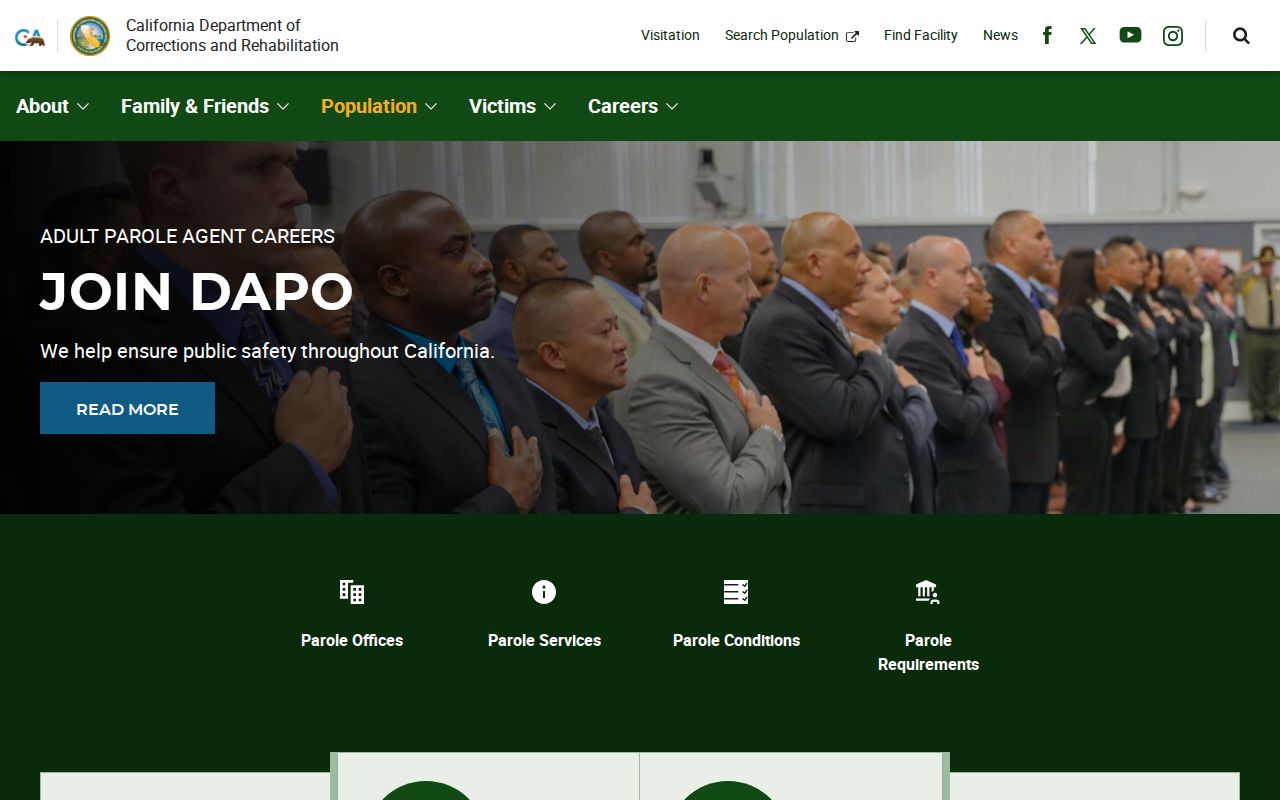
Use that state source only when the person is in the CDCR parole path. For county probation, the Yolo court and Probation Department remain the local route.